
Worried that the prospecting emails you send potential customers aren’t getting results? It might be time for a rethink.
Join me as I look at some examples of bad cold emails and how to write emails people want to respond to.
I don’t know about you, but I get a heck of a lot of emails from companies trying to sell me things.
A small minority of them are highly targeted and well-written. However, most of them are terrible.
Rather than sending these emails straight to the recycle bin, I’ve decided to make them a learning experience.
I’ll show you what these cold emailers have done wrong and how you can avoid making the same mistakes as them in your email marketing campaigns.
(If any of the emails on this page are a little small, just click to make them bigger.)
Cold email crime 1: You make it all about you
When writing web copy, whether for a landing page or blog post, it’s vital that you focus on the needs of the customer.
You need to identify your customers’ pain points and show them how your product or service can benefit them
The same logic applies to cold emails. If you harp on about how great you are, you’re not going to get anywhere at all.
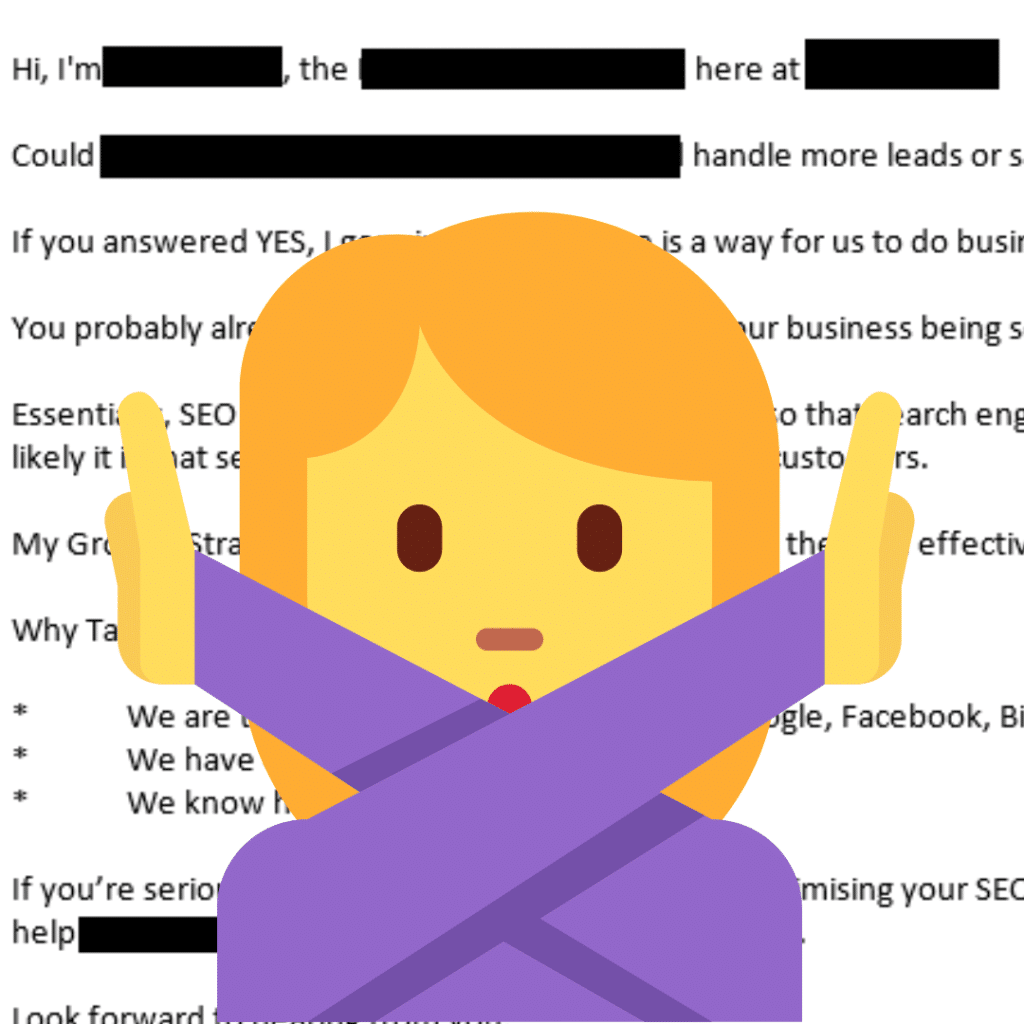
Email example
Copywriter Steve Harrison famously said that you need to count the number of times you say we in your content, versus the number of times you say you.

If you’re saying the former more than the latter, it’s probably time for a rewrite.
In the email above, number of we’s and ours: two. Number of you’s: none.
In situations like this, you can usually flip things around to the customer’s point of view fairly easily.
For example, the email talks about sales growth and market awareness. So you could write something like:
Looking for an innovative way to show off the unique selling points of your products and services?
We create short, snackable 2D and 3D videos that tell your customers who you are and what you do.
With our expert team, you’re one step closer to boosting your sales and raising your brand awareness.
Number of we’s and ours: two. Number of you’s: seven.
Boom. Mic drop.
Cold email crime 2: You write too much
Cold emails need to be short.
You want to introduce your brand, tell potential customers what you do, and explain the next steps you want them to take.
Save the longer, more descriptive emails for customers who are in the middle and at the end of the sales funnel.
Ideally, a cold sales email should be less than 120 words.
Email example
Here’s an example of a cold email that is way too long. This bad boy comes in at a staggering 325 words.
(Yes, I was sad and counted.)
People are busy, and their attention spans are short. The average person gets about 120 emails in their inbox a day.
If your email can’t be scanned and digested in less than ten seconds, you’re getting ignored.
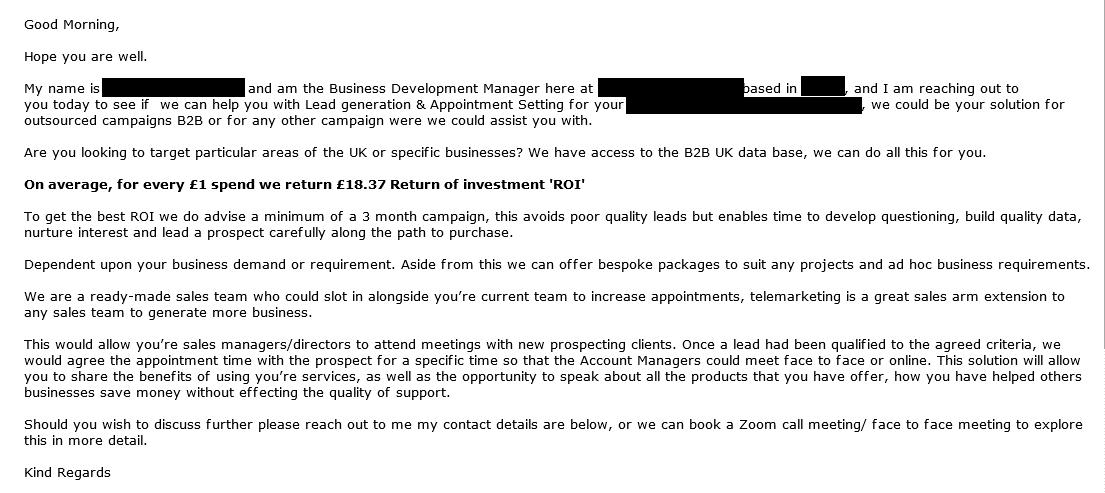
So, how can you reduce the length of this email? Here are my thoughts:
- Ditch the ‘hope you are well‘. The first line of an email is the most important as you need to grab the reader’s attention. Scrap the wishy-washy pleasantries; they don’t work
- The word choice is very fluffy. For example, you could condense the whole first paragraph to ‘If you’re looking for a lead generation and appointment setting provider to help with your B2B marketing campaigns, we’re here to support you’
- The email goes into extensive detail about how the lead generation process works. You don’t need this information in an introductory cold email. If anything, talking about how long a campaign needs to be is a turn-off. Save the nitty-gritty for a future email
This email does have some good things going for it. For example, it includes a tangible stat about the return on investment the company offers, which is great.
It’s just too wordy.
Cold email crime 3: You ramble on
A cold email should be a simple journey from A to B. You start by introducing yourself and your services, and end with a solid call to action.
If your email is a complicated road trip with multiple pit stops and having to pull over every couple of miles to check the map, you’ve got yourself a problem.
There’s a little bit of overlap with the previous category here, but an email can still be short and not have a point to it.
Email example
I got this email a little while ago – I read it and didn’t understand the point of it.
And I’ll be honest, I still don’t.
Let’s break it down step by step.
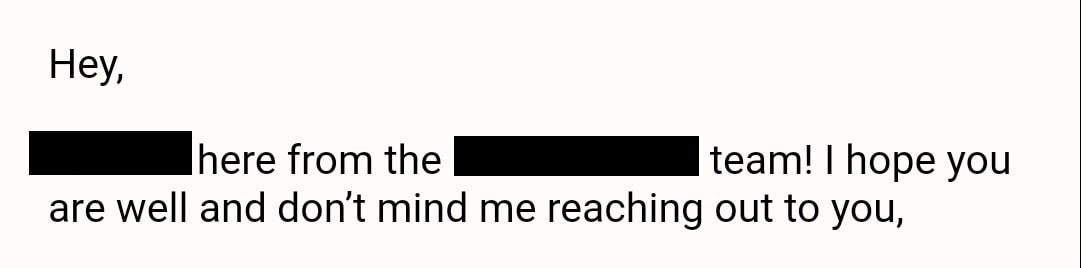
Fairly standard starting paragraph. Not a big fan of the ‘I hope you are well and don’t mind me reaching out to you’.
If you act like you’re being a nuisance, your reader is going to think you’re being one. Be confident in what you’re pitching.
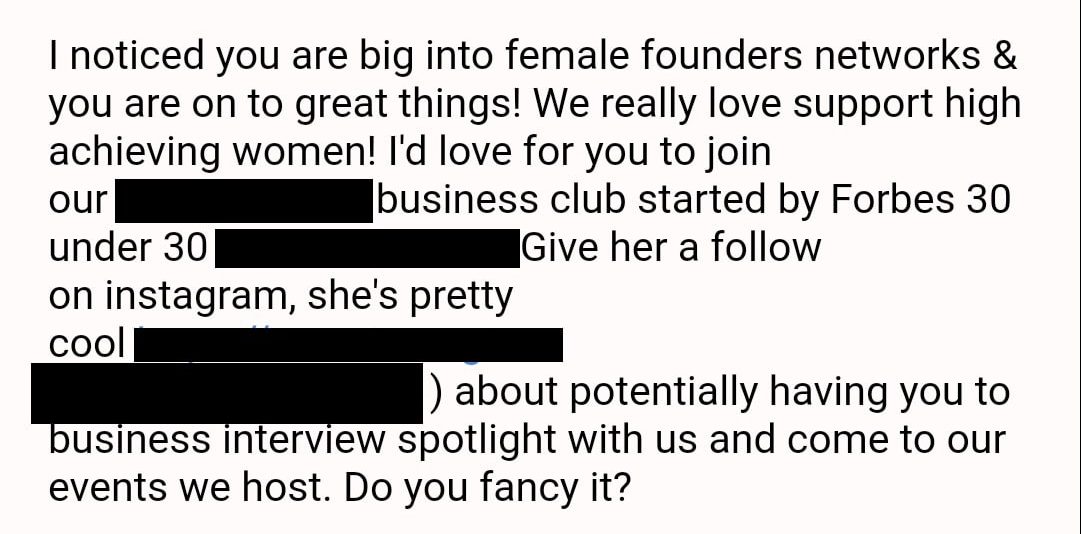
This is where things get weird. Not only is the writing clunky, but there are three different calls to action here.
The first is to join a business club, the second is to follow a woman on Instagram, the third is to arrange some kind of interview to see if I’m eligible to go to their events?
With a cold email, you need to stick to one main focus. When you try to get a prospective customer to do many things, you just confuse them.
Pick a lane and stick to it.
I would also avoid putting links and attachments in your initial cold email, like they did with the founder’s Instagram account here. This can distract and confuse the reader.
If you need to include links and documents, stick them at the bottom of the email so they’re out of the way, rather than in the copy.
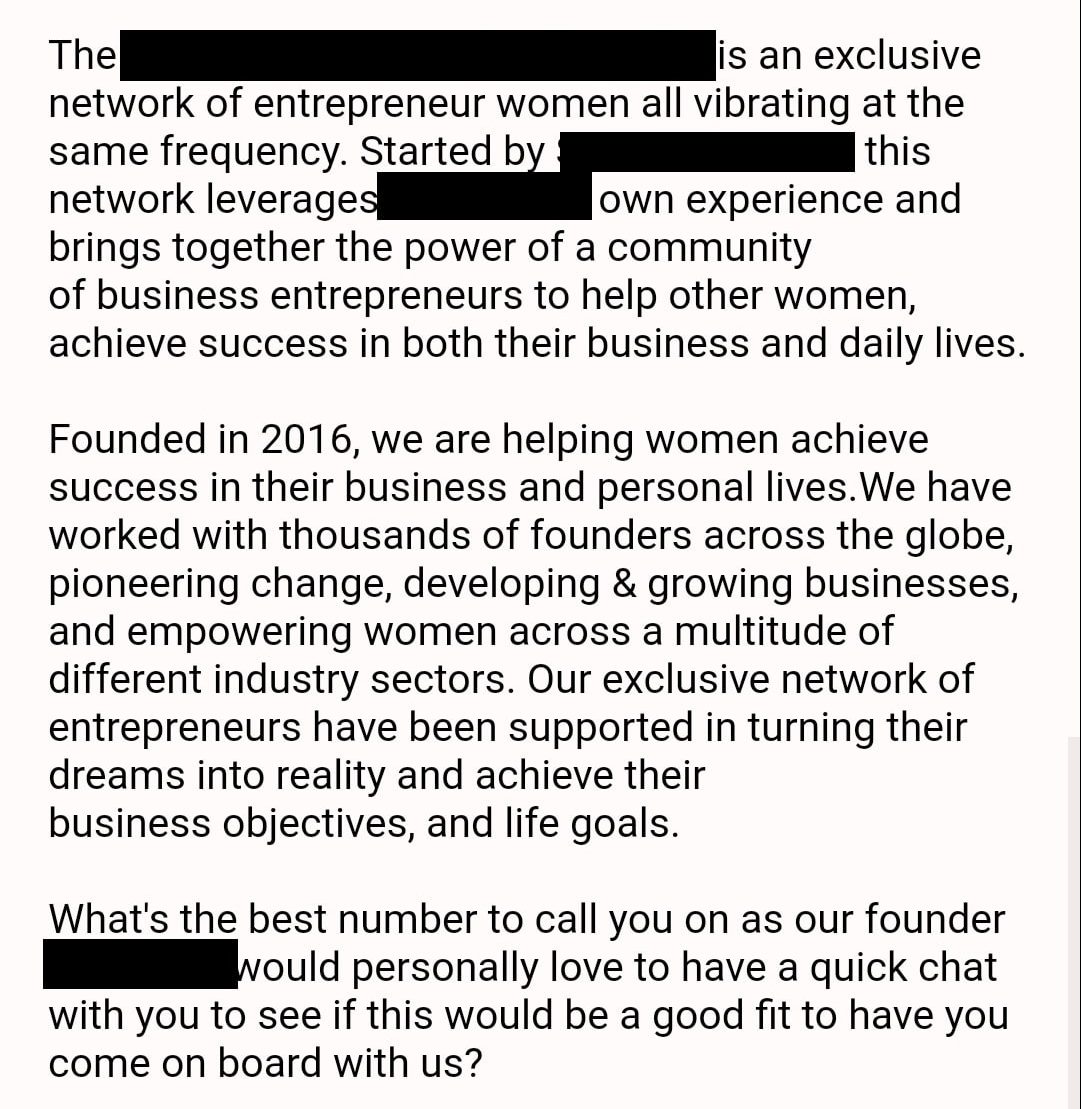
The final part of the email is a bit meh. There seems to be a fixation on how amazing the founder is, which doesn’t work well here.
You can easily condense these three paragraphs into one – a quick introduction to the group, who it’s for, and how you can benefit from joining.
Done and done.
Cold email crime 4: You try and be too clever
Did you know the average reading age in the UK is 9 years old?
On top of that, people are only going to scan an email for a few seconds before deciding whether it’s something they want to interact with.
This means you need to keep your wording clear and avoid complicated phrases that are going to make your readers need to dig out their dictionary.
Email example
Here’s an example of weird wording that I spotted in a cold email.
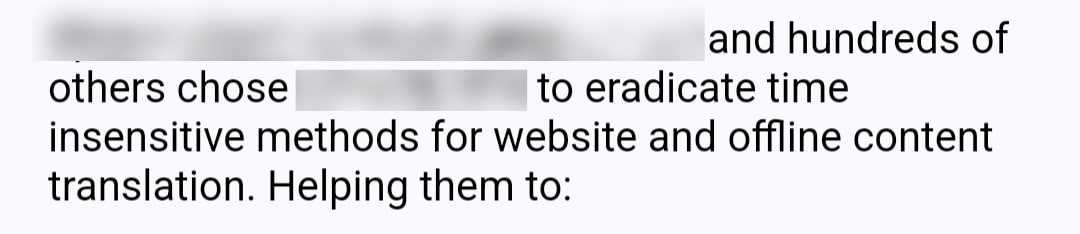
‘Time insensitive methods’ is not an easy phrase to understand. I’d have stuck with saying something like ‘hundreds of companies use us to save time.’
More words? Yes.
But it’s an easier concept to understand.
Cold email crime 5: You’re just too boring
We talked about being too clever and complicated, but the needle can swing too far the other way as well.
It’s possible to send an email that tells potential customers absolutely nothing about you.
Email example
Here’s an example of an email that’s as bland as an unseasoned piece of chicken.
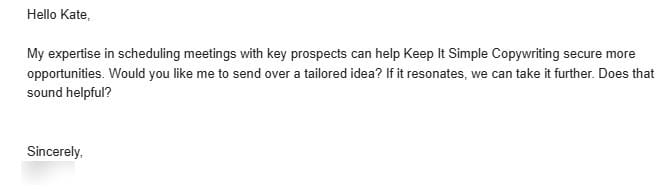
When you work in lead generation, you need to ensure your emails are attention-grabbing and compelling to encourage people to want to find out more.
However this email is dry, dull, and quite frankly, uninspiring.
It doesn’t tell me anything – what expertise do you have? How can you help my business grow?
Don’t ask your prospective customers to fill in the gaps.
The worst thing though, is the number of questions it asks. Questions can be a useful tool in cold emails, but not if they give customers a potential out.
Don’t ask anything that anyone can say no to.
Cold email crime 6: You don’t personalise
Many people think that cold email is all about grabbing a list of addresses and firing off the same generic email to them all in the hope that someone takes the bait.
Nope. Personalisation and targeting are important no matter what part of the sales funnel you’re focusing on.
You need to do your research and craft your email so it appeals to the reader.
Email example

The frustrating thing about this email is that with a couple of minutes of extra research, it could have been a great effort. It just doesn’t itch that scratch.
‘I was genuinely impressed by your outstanding work’.. like?
‘I’d love to be part of what Keep it Simple Copywriting is building’… which is?
Here’s how I’d word this one to get better results.
I recently came across Keep it Simple Copywriting – I loved your article about how to rank in Google in spite of AI Overviews. I’ll be bookmarking it for sure!
I’m sure you’d love to write more articles like this next year. If so, I can pick up your boring admin tasks for you, meaning you have more time to create amazing content. How does that sound?
Same gist, but more personalised and targeted.
(And shameless plug, here’s that article about AI Overviews if you want to check it out.)
Cold email crime 7: You personalise *too* much
At this point you’re probably thinking ‘Kate, what are you going on about?! You want me to use personalisation, then you don’t. Make your mind up!’
It’s vital to personalise your emails so you appeal to your potential customers. However, it’s easy to lay it on too thick.
If you use too much personalisation, you risk coming across as insincere. You could also freak your prospects out, meaning they don’t want to work with you.
Email example
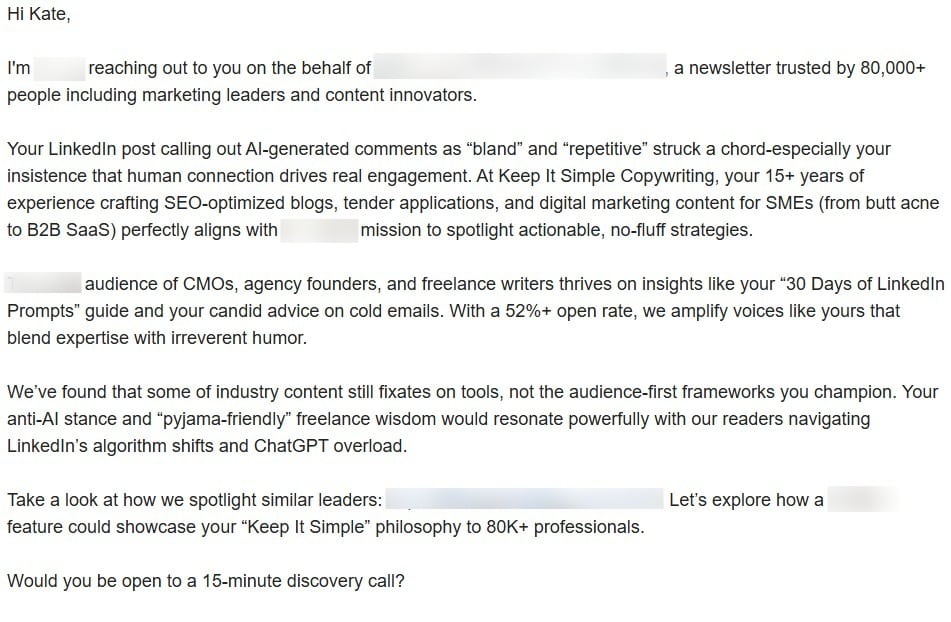
This email was a lot. I counted four separate (and rather large) instances of personalisation in a 220-word email.
I think the issue I have with this email is that rather than trying to solve my problems, it exists solely to inflate my ego.
Which is nice and all, but it doesn’t make me want to advertise with this company’s newsletter.
The email also feels a little ‘by the numbers’ – ‘insert a fact about the prospect’s latest LinkedIn comment here’, ‘talk about one of their blog posts here’ – which feels forced and ungenuine.
How would I improve this email? Focusing on quality rather than quantity.
You could reference one popular social media post or article, ask your prospect if they want to share this kind of knowledge with the world, and offer your newsletter as the ideal platform to do it on.
Cold email crime 8: You don’t do your homework
Due diligence is everything when you’re sending cold emails.
Get your information wrong, and you risk not only annoying your prospective customers but also them telling everyone that you’re, well, a bit of a dunce.
Email example
Being a local business that’s close to a prospect can be a fantastic unique selling point. You know the area, you know all the key players, and you’re only five minutes away if they need help.
However, if you’re sending cold emails that are playing up the benefits of being local, you need to make sure you’re in your prospective customer’s proximity.

This accounting firm has offices in two locations. Both of which are a three-hour drive from where I’m based.
I don’t know about you, but I wouldn’t classify that as local.
It’s important to look at where your prospects are based before you fire off your emails. If they’re not in the same town or city, choose a different angle than ‘hey, we want to be your local accounting partner.’
Cold email crime 9: You don’t give customers a reason to trust you
We’re all tempted to lie on things – CVs, mortgage applications, tender submissions.
However, just because you can doesn’t mean you should.
Emails are all about building a relationship with a potential customer. You want them to trust you enough to want your product or service.
Break that trust, and it’s all over.
Email example

They’re just getting started and they’d love to get some advice from a expert such as yourself. Flattered, you agree to jump on a Zoom call.
However… they don’t want your valuable insights at all. They just want to sell to you.
The tell-tale sign that gives this email away is that it’s inauthentic and vague – the person probably sent the same email out to 500 other people.
If it was genuine, they’d have mentioned something specific they liked about my work.
When you send emails like this, you’re starting your working relationship on the wrong foot. You’ll trick someone into a call sure, but they’re not going to buy from you.
And after they’ve hung up on you for wasting their time, they’re going to tell their network to avoid you like the plague.
Cold email crime 10: You resort to shady practices
So far, all the issues we’ve looked at can affect your click-through and conversion rates. This one can get you into actual trouble.
Yep, we’re taking a look at the businesses that don’t take no for an answer, understand the rules, or don’t know what ‘unsubscribe’ means.
Email example
This initial email came from a lead generation company.
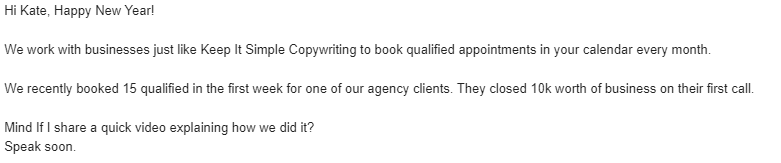
I always reply and say I’m not interested if I get a cold email for a product or service I don’t want.

When I worked in sales I always appreciated it when someone said ‘no thanks’, as it meant you could cross them off your list and move on to other leads.
Plus, if you say something, you stop getting emails.
Well, you should stop getting emails.
So a couple of days pass, and I get the following email from the same company.
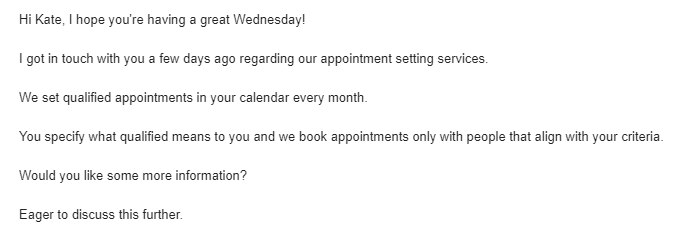
I emailed them again to ask them to take me off their list. Bit annoying, but I’m sure it was a simple oversight, right?
Right?!

A few days later…

Nope, that’s not cool, so I responded again.

Thankfully third time was the charm, and they didn’t contact me after that.
Am I being a bit melodramatic here? Probably.
But data protection regulations like GDPR say that if someone asks you to unsubscribe them, you have to honour their request.
As this is a lead generation company, it also looks bad from a business perspective.
If I used this business to reach out to potential customers and book appointments, would they hammer people with emails and ignore them if they told them to stop?
It’s not something I want going on in my name.
And it’s a shame because this email sequence was pretty good.
It was short, it was well set out, and it talked about how previous customers had reaped the benefits of their service.
But you can’t ignore potential customers – that’s a huge no-no.
So send cold emails, sure.
But do it ethically and in line with your country’s data protection requirements.
(And yes, the UK still follows GDPR regulations despite Brexit taking place. Sorry.)
Cold email crime 11: You get sloppy
A cold email is likely to be a prospective customer’s first interaction with your brand, so you need to make a good first impression.
Throw out an email that’s riddled with spelling mistakes, broken links, and images that look like they were vomited up by Microsoft Paint?
Wave goodbye to your potential clients.
Email example
It doesn’t matter how new your website is, how awesome it is, or how many conversions it drives – you’ll always get cold emails from companies asking if you want to redevelop it.
Case in point, this email I got from an agency asking if I was in the market for a new site.
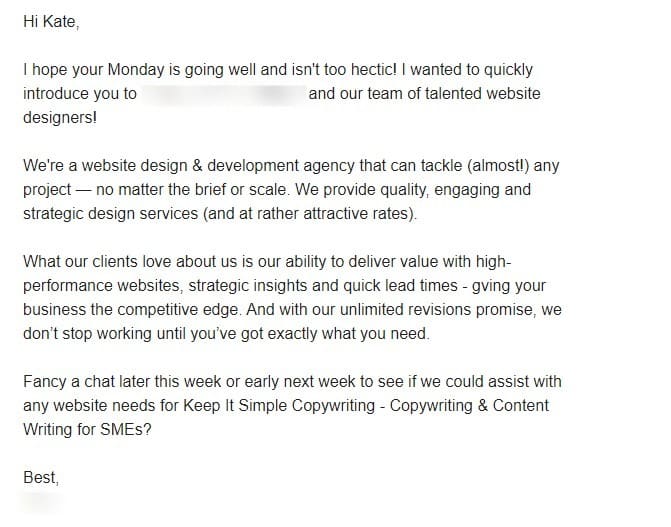
There are too many brackets/parentheses in this email. You want your initial email to be easy to read, and adding brackets for the sake of it can interrupt the flow.
Plus, qualifiers like these makes you come off as unconfident. Say you can handle any project in your first email, and worry about saying no later down the line.
Now… let’s zoom in a little…

Ooof.
When you’re selling a service where attention to detail is vital (like web design and development), you need to be on the ball.
After all, if you can’t be bothered to run a spell check before hitting the send button, are you going to sense check your code?
In a cold email you need to make sure you’ve crossed all the t’s and dotted all the i’s before sending your messages out to potential clients.
Otherwise it could lead to rejections you could have otherwise avoided.
Cold email crime 13: You patronise your prospects
One of the quickest and easiest ways to alienate a potential client is to be rude, treat them like a toddler, or underestimate their abilities.
Email example
Here’s the start of an email that rubbed me the wrong way.

This cold email contained not one, not two, but three smiley faces.
While I love a well-placed emoji, I don’t think cold emails are the place for smilies – they come across as smug and insincere.
If you’re using them to try to be friendly, you may want to rewrite your content instead.
However, that’s not the main issue here. This email asks me to pass the message on to my directors.
First, I’m not a limited company, so my business doesn’t have directors. A quick visit to Companies House would have cleared this up.
Second, I own the business, so asking me to forward the email across to my supposed bosses is incredibly disrespectful.
It’s the equivalent of taking your car for a service and the technician ignoring you and explaining the results to your husband.
Examples of cold emails that are actually decent
I’m not a negative person.
I might be dismissive of the majority of cold emails that land in my inbox, but I do get some that aren’t too bad.
I’ve listed them here, alongside what I’d do to make them better.
Email example 1
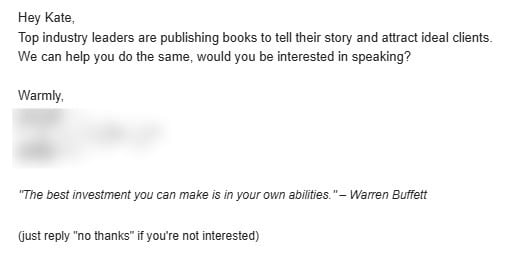
While I wasn’t interested in what this person was selling, the email itself was clear and to the point.
No bragging about how great the company was, no convoluted paragraphs asking if I was the right person to speak to. Just ‘this is our product, this is how it can help you, this is how we can move the conversation forward’. Done and done.
That being said, there are two things I would do to improve this email.
First – add an unsubscribe link. While asking people to email you back if they want to be taken off your list covers you under regulations like GDPR, an unsubscribe link is better and means less work for you.
Second – scrap the quote. A lot of cold emailers include a quote from a famous person, thinking that it shows off their personality and brand values.
The problem is that if you choose the wrong quote and the wrong person, it can turn a prospective customer off.
I once got a cold email from a (US-based) company that thought it was a good idea to include a quote from Margaret Thatcher in an email to a Northern-based business in the UK.
Spoiler alert: It wasn’t.
Email example 2
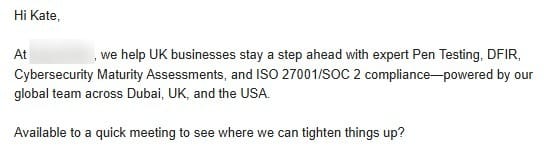
What I like about this cold email is that it’s short – this email covers everything in under 50 words.
It understands its target audience. There’s no long-winded explanation of what cybersecurity and penetration testing is and how it can benefit your business, because the people who get the email already know.
Again, like the email above, this message could do with an unsubscribe link, but apart from that, no notes.
Email example 3
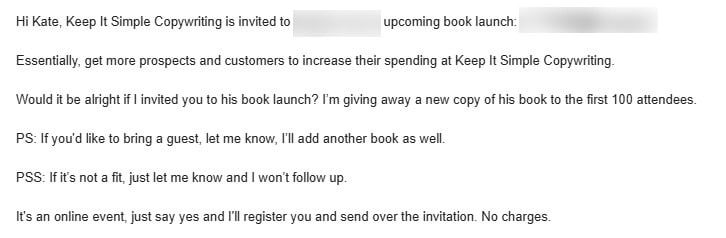
Like the other emails in this section, this cold email is short and gets right to the crux of the message. I like how it’s spaced out too – which makes it easy to scan and understand.
If I were to be picky, I don’t care for the third line ‘Would it be alright if I invited you to his book launch?’ – this is a bit wishy-washy.
I’d say something that’s more direct, like: ‘I’d like to invite you to his book launch.’
So, what can you do to write good cold emails?
Here’s a summary of what to bear in mind when creating cold emails to send to prospective customers.
Prioritise the customer
Your cold email should talk about your customer’s issues and how you can help them.
Don’t talk about your brand and how great you are.
Make sure you get the name right
If you mess up the recipient’s name or get the name of their business wrong, you’re going to struggle to make a comeback.
Use personalisation
Cold emails don’t have to be cold and generic.
Take the time to find out something about each customer and weave it into your message.
However… Don’t take things too far, as you may creep your prospect out.
Keep things short and to the point
Keep your first email under 120 words.
Read through and if anything sounds like filler, drop it.
Be careful with questions
Questions can pique a reader’s interest, but don’t ask a question they can say ‘no’ to.
You need to understand your customer and what they want.
Stick to one focus point only
You should have one clear call to action, and your copy should guide the reader towards that call to action.
I’d also avoid links and attachments – the fewer distractions, the better.
Keep your wording simple
Avoid jargon and difficult words unless the situation calls for it.
Be confident
If you’re nervous or unsure, it will come through in your email copy.
Be honest
You want your working relationship to be honest and forthright from the start.
Avoid lying or making any claims about your products or services that could be misinterpreted.
Don’t treat your customer like an idiot
Nuff said.
Don’t be patronising
Speaking down to your prospects is a surefire way to lose their custom.
Honour unsubscribes
If someone asks you to take them off your list and not contact them again, do it.
Run a final spelling and grammar check before you send
Sloppy spelling and grammar say more about you than you might think.
And of course, if you want to write cold emails that drive conversions but don’t know where to start, a good copywriter can help.
If you’ve read all the way through to the end of this article, it may interest you to know that I have over 15 years of experience writing emails for B2B and B2C businesses.
Drop me a line if you want to know more.